Meyhane : Turkey :: Dim Sum : China

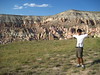
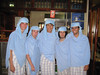
Tonight was a tasteful occasion. I convinced Hande, our Turkish teacher, to have Turkish lesson at a meyhane instead of at our flat. After painstaking hours of burdens of proof, cases, cross examinations, and rebuttals she final conceded that it was comparatively more advantageous to have Turkish lessons at a meyhane than at our flat. Debate surely paid off this time. A meyhane can be described, for those cultural connoisseurs, as a variant of the well-known Asian dim sum experience. Instead of push-carts loaded with various selections of foods, soups, deserts, and other unique items the meyhane servers bring around a large platter that is shown to the customer at the beginning of the meal. The guests then choose the mezes (may-zays) from the platter; however, the mezes on the platter are not the ones the guests eat. The ones on the platter are for display only. Here's a picture of us at the meyhane.How could I forget to mention the raki? At the meyhane it is customary to have raki with your meal, and usually your main course is fish. At this particular meyhane, I ordered 'fish on tile' which was some of the BEST fish I have ever had. I have yet to get accustomed to the taste of black liquorice (raki), but hopefully by the end of the trip I will have acquired the taste for this Turkish drink.

Call To Prayer

This is what I hear 5 times a day, everyday ringing throughout the city. This is one of the things I will miss when I go back to the States. The Call to Prayer is sung by a trained religious man. In Turkey, secularism is defined differently than it is in the United States. In the U.S., we all see secularism as separation of church and state, but in Turkey secularism means governmental control of religion. In other words, the government has a hold upon all of the mosques and religious figures. In order to become a religious figure such as an Imam, one must undergo governmental training before one is able to serve in a mosque or sing the Call to Prayer. Turkey has many practices that are incomprehensible to our Western minds. Perhaps someday this nation will actually see its faults and become great. Until then, here's the government-trained Kalendarhane Mosque mu'adhdhin (muzzein) singing the Call to Prayer.


Mufti, anyone?

We started the day at the medrese (school) finishing our Turkish history time line. Finally, I scavenged the intelligence and courage to engage in our discussions in class. I think that I definitely added to our dialogue of the reasons for the consistent turmoil Turkey continually found itself in. After this we went to Suliyemaniye to meet with Istanbul's mufti (head of the department of religious affairs in Istanbul).

The mufti had previously met with the Pope two years before! Our meeting with him was met with a barrage of less-than-intelligent questions from the two other groups we were with. The questions were extremely antagonistic, attacking the mufti and the Turkish government. Our group agreed that our representation was hurt by the unintelligent inquiries. Luckily, the last question was uttered from a member of our group and had some semblance of intelligence. And good thing that person was me. :) After the mufti we headed over to Yildiz University, our third institution of higher education during our 4th week in Istanbul.
We met with Professor Gulalp, current dean of the Political Science department, as well as former professor of sociology and political science. Our time with Professor Gulalp was quite interesting as he allayed our prognostications of civil unrest if the AKP party were overthrown by the Supreme Court. He also helped us understand the Turkish bureaucracy by placing it within the context of Rousseau's Social Contract. Rousseau made a distinction between the General Will (good of the people) and the Will of the People (what the people wanted). In application, a government is to act for the General Will even though it may be contrary to the popular will. In Turkey, the military represents the General Will, stepping in when the elected governments (Will of the People) stray too far from Kemalism (the paradigmatic ideology of Ataturk Kemal). This interpretation of Rousseau was extremely interesting--it put Turkey into a context that I could understand. Then the question arose, "If the military determines the General Will, what prevents it from decreeing an incorrect General Will?" Professor Gulalp said there was no way of ensuring the General Will be carried out. Questions continued and came to an end with another one of my questions. After Professor Gulalp, we had dinner at Professor Shields's house--an amazing event in and of itself.
After dinner we stumbled across Prostitute Lane, 1 lira Efes (Turkish beer), and a bowling alley. A great end to a great day!

Information Overload

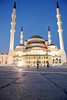
A day full of interesting facts about Sultanahmet (Blue Mosque) and the Hagia Sofia. Here are some pictures throughout the day. To show his superiority to Suliyemaniye (Ahmet's idol), Ahmet included 6 minarets in the design of his mosque (I couldn't capture all 6 minarets in the photograph). Among other things, the Blue Mosque is still a mosque Muslims go to for prayer, especially during large holidays such as Ramadan. Throughout history, people have created myths surrounding this mosque believing it has healing powers. With such grandeur and majesty who wouldn't believe that?


Sultanahmet

Inside
Our next stop was the Hagia Sofia, famous for the sheer amount of mosaics inside. A former church, Hagia Sofia was converted to a mosque during the conquering of Istanbul. You will notice the numerous Christian mosaics that remained inside Hagia Sofia when it was converted, but also the 'tacked on' Arabic/Islamic symbols. Built in the 6th century, it is amazing that so many of these mosaics are still in tact. Built with architecture and sophisticated calculations that went into the building of Hagia Sofia makes it able to withstand a 7.5-Richter earthquake!

One of the Many Mosaics

Something Look Odd?

Look Familiar?

The Mihrab (placed in the direction of Mecca)
An interesting fact about this Mihrab was that since it the mosque was converted from a church, the mihrab is actually 30 degrees North of the actual direction of Mecca in order to face the congregation and accommodate times of prayer.The Slab was Cut In 1/2 for Symmetry -- Genius!
It took 120 hours between 2 men to cut through the marble! This was one of DOZENS!

After 1600 Years, Hagia Sofia has Shifted A Little...

Work Your Magic, We'll Meet You By The Tiles

Sufism. The majority of our morning was spent on this ambiguous noun. We had the pleasure of speaking to the head of an NGO (names of which I do not recall) and her thoughts about women in Islam, scarves, Sufism, and a variety of other questions. Most, if not all, of her answers had the word love and Mashallah (the most similar to the word: wonderful). To my ears, she sounded like a modern day hippie. Peace and love would solve all of the issues in the world. Her simplified view of the world did not help her clarity in her responses to our questions, in particular What is Sufism? After a few hours of questioning the women served us lunch, and we were off to Sirkeci Train station.
Today was the first on-site presentation of the class. Kristina and Emily led numerous intellectual discussions of the significance of this grand monument and the impact of the Orient Express. One thing that struck me was the color of the ceilings. All of the beams were pink. Now what interior designer or person would decide to use pink as the color to express grandeur, luxury, and sophistication? This remains a perplexing question... After the Sirkeci stop we had a couple of hours before our Sufi zikr (worship service/meeting).
In the 2 hours, we decided to go to the Grand Bazaar and purchase my long-awaited puse (pronounced poo-shee). There's a picture of me and my newly-acquired puse. Yekta, our native Turk, Amanda and I engaged in covert operations. I would send Yekta to a store and have her pretend she was buying a puse. "Work your magic, We'll meet you by the tiles." This is a sample of some of the dialogue that occurred during our purchasing adventure. Whenever she found one, Amanda and I would pretend to look at other scarves and talk to Yekta through each other. I would call Amanda Yekta and tell her which puse I wanted and the price I wanted to pay. In the end, it was another successful mission!


The zikr was an experience! Here are a few pictures attempting to show glimpses of the scene:

Whirling Dervish (religious practice)

Again
...and the party afterwards!

Mission Impossible


For class today we were able to return to the golden ages of 5 and 6 and play pretend! The Theodosian Walls, or what I like think of them as, The Great Wall of Turkey, extend for 6 kilometers throughout Istanbul. Construction began in 408 and upon finishing the walls were only penetrated twice within the long history of the Theodosian Walls’ active use. Since the practicality of the Walls, they have become somewhat decrepit adding a sense of age, genuineness, and uniqueness to the landscape that few other places that I have visited embody. From 10 to 5, I was able to climb up and down walls, towers, and dungeons pretending to be Superman, Spiderman, a knight in shining armor, Agent Hsyeh on a mission, and anything else my imagination and situation led me. The hands-on approach let me experience the city and see the beauty of this magnificent city. There is truly no place like Istanbul as you scan city and pinpoint Aya Sofia, Sultanahmet, Galata Tower, the Bosphorous, and the array of diversity that paints such an eclectic, yet complete painting.

Agent Hsyeh--Mission 1246ZI: Save Istanbul


Being Caught and Locked Up

Different Angle

Being Held at Gunpoint to Jump


Victorious Smile After Pushing the Gunmen Down the Wall

After Saving Istanbul


After Finishing My Mission

Another day...Another successful mission

--Agent Hsyeh

Weekend, Take 1

After class on Friday, which consisted of a short discussion about Ataturk and Turkish history AND another amazing Turkish lesson (during which I was experiencing excruciating bowel problems), we headed off to Bursa! This is when the adventure truly began. Getting to Bursa was analogous to entering the twilight zone (cue the eerie music).
The journey begins as we head towards Taksim via Istiklal Caddessi (pronounced JAH-DEH-SEE, means Street). The street is packed as we trek towards the Nilufer station (bus company we are using) with our backpacks and duffels stuffed full. Before I move on here is a little background to the trip. Professor Shields had been planning a trip to Bursa for a while, and Murat, our Turkish friend, happens to be from Bursa. Well, I took the opportunity to invite myself to his home since he happened to have planned a trip home the same weekend we were going to be in Bursa. The planning spanned over the course of 3 days as we were trying to communicate plans to Professor Shields, the rest of the gang, Murat, and Murat's friends. The night before the big day, we sat down on the terrace with Murat and ironed out some, well all, of the details. In the course of 2 hours, the Americans gleaned numerous different interpretations as to how Friday was going down. I cannot explain the pains all of us experienced, Turks and Americans, as we tried to communicate the plans for Friday. Luckily, that night I had chosen to try a new beer, the Marmara-- it proved to be our saving grace. The Marmara just happened to be the hotel next to the street that our bus company was located. Using this beer, Murat finally got across where the bus station was supposed to be. We were set for anything that was to come! After this long-winded dialogue/cacophony, we decided to go try some nargile (hookah/water pipe). Little did we know that the restaurant serving nargile was going to be on the 8th floor overlooking the entire city. It was a sight to see! After a few puffs of elma (apple) and mint nargile we finished Thursday's adventures and retreated home. Then Friday rolled on over--a test of our sanity.
After finally finding the bus station, only to watch our bus drive off without us, we found out we had to wait an hour and a half before catching another service bus that would take us to the action bus station. By the way, Friday also happened to be the start to a long and strenuous venture in my bowels :) Oh yeah, I forgot to mention this, but Murat, a few minutes before we left to smoke nargile, decided to tell us that there was a change of plans: he wasn't going to meet us in Kavacik, instead he was going to be arriving in Bursa in the wee hours of the morning. Moving right along, we get on the bus and arrive around 6:30 realizing that we must have missed our 6:15 Bursa bus. However, we come to find that the 6 o'clock Bursa bus just rolled up and left, so we patiently waited for our turn. Buses continually pulled up and left, the workers continually shouted in Turkish, and everyone at the station continually stared at us--a walking UN conference comprised of representatives from Germany, Albania, China, Ecuador, England, and whatever else they perceived ALL speaking English. Our bus finally showed up around 7 and with the help of a couple of Turks we ended up getting on without too many complications. Here comes the fun part! Traveling with seven people and sitting on a bus with paired seats, one of us was going to be the odd man out. I volunteered to be the odd man out because I was sick and developing a fever--what a great start to a weekend trip. The bus ride, one that was supposed to last 3-4 hours, ended up taking 6+ hours!
The situations we experienced on the bus made the trip to Bursa semi-creepy and foreboding. A little into the trip, the bus stopped at a second pick-up point where the rest of the seats were filled. Instead of leaving me the odd man out, somehow, with our strategic maneuvering, I ended up sitting next to Clayton, leaving Amanda with, who she called, a 'mystic' Turk. What an intriguing, curious, but odd man he proved to be. The bus ride was going swell, with most of the other students being ebullient and full of giggles, me and my doubled-over position, and the rest of the bus mumbling Turkish obscenities at every noise uttered from the Americans' mouths. Then, the bus started descending towards a large body of water, where all of us thought was going to lead to a small road. Oh, were we in for a surprise. The small road turned out to be a large parking lot guarded by uniformed militia. In reality, what looked like a large parking lot actually was an organized system to load us onto the ferries that would take us across the Sea of Marmara (Marmara played a significant role in my life this weekend). To Be Continued…

Ferry


IMG_4745

IMG_4982

IMG_1910_edited-1

IMG_1869

IMG_1417

DSC_0204-4_edited-1

DSC_0045-8_edited-1

IMG_4154